Date/Time:
Tuesday, February 12, 5:30
Location:
Elizabeth Irwin High School - meet in the library
40 Charlton Street
(between 6th Ave and Varick)
What We're Reading:
Hokey Pokey by Jerry Spinelli
Just One Day by Gayle Forman
Thursday, January 17, 2013
Wednesday, January 16, 2013
We Came, We Debated, We Had a Mock Printz
What will hopefully become an annual event had a great start this past Saturday afternoon. Thirteen HVLA members and friends gathered at LREI – Little Red School House & Elisabeth Irwin High School for a Mock Printz co-hosted by HVLA and SLJ’s
Someday My Printz Will Come blog. Karyn Silverman of Someday served as our Printz expert.
The afternoon began with soup, sandwiches and socializing.
Being mostly independent school librarians in Manhattan, it’s no surprise that some of us were suffering from, or recovering from, the cold that everyone in the NY metro area seems to have. Luckily, Karyn and I were prepared with Cold 911 from David’s Tea (our not-so-secret obsession), and we served up a few pots before getting down to our discussion.
All of our titles were written on a white board in alphabetical order by author’s last name. To save our limited time for in-depth discussion, we did a quick poll (by show of hands) of everyone’s top-five books. The Drowned Cities and Aristotle and Dante Discover the Secrets of the Universe received the lowest number of votes, which matched the results of our original nominations poll.
We decided to discuss the books in the order they appeared on the board, putting The Diviners by Libba Bray up first. This was also our first opportunity to review the Printz policies and procedures, which Karyn helpfully wrote on the white board for easy review. Whether The Diviners succeeds as a standalone book was a main topic of our discussion, as was Evie’s emotional journey, and the character development overall.
A.S. King’s Ask the Passengers was
largely praised as thematically strong, with great characters and a strong
authorial voice. Magic realism was judged an asset to this story about
identity, which in one member’s opinion bears the refreshing message that it’s
okay not to have it all figured out as a teen. Other members noted that this
isn’t just a great “coming out” book, it’s a great book with “coming out” as a
part of the narrative.
Before discussion started we acknowledged that none of us had read every title, but that we would do our best to give informed opinions when possible and lean on those who had read a particular title. One of these was Margo Lanagan's The Brides of Rollrock Island, which had our members questioning if it is actually a YA title. Karyn informed us that on a real Printz committee, the chair and members would agree prior to discussion if a book published as YA (but judged by committee as not really a YA book) would meet criteria. This was an important designation to note, as the Printz criteria certainly covers the publishing distinction, but not the critical.
This first round is so interesting because CNV narrowly edges out ATP, but ATP placed on every member’s list save one. To win, a book needs to receive 50% + 1 first place vote, which means that we needed to vote again to get our true fake winner.
Second round voting in the Real Printz should follow another round of discussion, often focusing on the books that dominated the top votes, but in the interest of time and excitement, we went straight to the voting. Karyn advised us to vote strategically in order to reach a decisive winner; therefore, a member could sway the vote to CNV or ATP by changing their first place vote. With that in mind, here’s the second round breakdown:
Being mostly independent school librarians in Manhattan, it’s no surprise that some of us were suffering from, or recovering from, the cold that everyone in the NY metro area seems to have. Luckily, Karyn and I were prepared with Cold 911 from David’s Tea (our not-so-secret obsession), and we served up a few pots before getting down to our discussion.
All of our titles were written on a white board in alphabetical order by author’s last name. To save our limited time for in-depth discussion, we did a quick poll (by show of hands) of everyone’s top-five books. The Drowned Cities and Aristotle and Dante Discover the Secrets of the Universe received the lowest number of votes, which matched the results of our original nominations poll.
We decided to discuss the books in the order they appeared on the board, putting The Diviners by Libba Bray up first. This was also our first opportunity to review the Printz policies and procedures, which Karyn helpfully wrote on the white board for easy review. Whether The Diviners succeeds as a standalone book was a main topic of our discussion, as was Evie’s emotional journey, and the character development overall.
The Fault in Our Stars came next. John Green’s novel had received the
64% of the votes in the nominations round, and while there was a lot of love for
John Green, we had to wonder if he was bigger than the work itself. Ultimately,
we agreed that although voice and style were strong, the plot and some of the
characters were flawed.
Before discussion started we acknowledged that none of us had read every title, but that we would do our best to give informed opinions when possible and lean on those who had read a particular title. One of these was Margo Lanagan's The Brides of Rollrock Island, which had our members questioning if it is actually a YA title. Karyn informed us that on a real Printz committee, the chair and members would agree prior to discussion if a book published as YA (but judged by committee as not really a YA book) would meet criteria. This was an important designation to note, as the Printz criteria certainly covers the publishing distinction, but not the critical.
Plot, theme, and
characters dominated the discussion of David Levithan’s Every Day. Some members took issue with the pat moral lessons, and
the implication that A could understand the life of a person after living in
their body for just one day. However, we agreed that the Levithan challenges readers to face their own biases.
Railsea by China Mieville was
another title that was sadly under-read by our group, but Karyn made a good
case for its world-building and wit. Collectively, we marveled at Karyn’s copy
heavily laden with post-it flags.
We returned to our
series vs. standalone debate with The
Raven Boys. It seemed like we all heart this book and Maggie Stiefvater, but there was some
disagreement on the richness of the characters and themes. Some felt that
although parts of these elements are established in this book, it’s too evident
that more is to come in future books.
Finally, we discussed
our second place title in the nominations round: Code Name Verity. Although it didn’t touch everyone emotionally
(i.e.: not all of us cried), we agreed that superior craft is on display in
Elizabeth Wein’s book.
When it came time to
vote, there was definitely excitement in the air. Having been snacking on
candy, pretzels, and tea, we were fueled up and ready to back our favorites. In
secret ballots, we each ranked three books for Mock Printz gold. Each first
place vote was worth 5 points, second place 3 points, and third place votes
were worth 1 point. (In the excitement of the afternoon, we accidentally gave TFIOS one extra second place vote that
was meant for CNV, but the difference
is negligible). Here’s a look at how the votes fell:
![]() |
| Click to enlarge the table. |
This first round is so interesting because CNV narrowly edges out ATP, but ATP placed on every member’s list save one. To win, a book needs to receive 50% + 1 first place vote, which means that we needed to vote again to get our true fake winner.
Second round voting in the Real Printz should follow another round of discussion, often focusing on the books that dominated the top votes, but in the interest of time and excitement, we went straight to the voting. Karyn advised us to vote strategically in order to reach a decisive winner; therefore, a member could sway the vote to CNV or ATP by changing their first place vote. With that in mind, here’s the second round breakdown:
![]() |
| Click to enlarge the table. |
Once again, running on
adrenaline we miscounted at the time so the breakdowns shown here are the result of
a second count. Although it didn’t win
by the true Printz margin, our Mock Printz gold went to Ask the Passengers, proving that consensus is just as important as
perfection when it comes to the Printz.
As in the Real Printz, we voted for Honor books separately. This was also an aha! moment for
many of us, as it became clear that although one might not vote for a certain
title for Gold, you may want to support a flawed but noteworthy book for an
Honor. With this in mind, our Mock Honor picks were: Code Name Verity, The Fault in Our Stars, Railsea and The Brides of Rollrock Island.
After a long day’s
journey into night, we not only came away with Mock Printz winners, but picks
for our February Book Club. The titles, date and time for our first meeting of
2013 will be announced here on the blog soon!
Head over to Someday MyPrintz Will Come for additional analysis and data on our Mock Printz. Thank you
to all who participated! Watch this space for details on how to participate in next year's Mock Printz sequel: bigger, better, more tea.
Monday, January 14, 2013
How to Deal with Pesky Teens
As a former public librarian for teens and current school librarian for middle school and upper school students, a video advertised in the American Library Association's weekly email titled "How to Deal with Pesky Teens" intrigued me. Of course, I would never describe my teens as pesky! At least, I would never say they are inherently a nuisance or intentionally annoying. Thankfully, I don't think the makers of this video think so either. Watch it for a primer in what to do with all those teens who come in your library for reasons other than using its resources (and let's face it, most of our older teens don't come for the books or our assistance).
What do you do in your Library to set boundaries or occupy the students who have nowhere else to go? Leave a note in Comments!
Wednesday, January 2, 2013
Mock Printz: January 12th!
Happy New Year, HVLA members!
We’ve been teasing it for a while and now HVLA & Someday My Printz Will Come are happy to officially invite you to attend this year’s live and in-person Mock Printz on Saturday, January 12, 2013.
WHO: HVLA & Someday My Printz Will Come
WHAT: Mock Printz Debate and Discussion
WHERE: LREI – Little Red School House and Elisabeth Irwin High School
40 Charlton Street, New York, NY 10014
WHEN: Saturday, January 12, 2013
12:30 pm – 1:00 pm Lunch
1:00 pm – 4:00 pm Debate & Discussion
As voted by YOU, here’s the short list of titles that we’ll be discussing:
The Fault in Our Stars, John Green
Code Name Verity, Elizabeth Wein
The Diviners, Libba Bray
The Raven Boys, Maggie Stiefvater
The Brides of Rollrock Island, Margo Lanagan
Every Day, David Levithan
Ask the Passengers, A.S. King
Railsea, China Miéville
Aristotle and Dante Discover the Secrets of the Universe, Benjamin Alire Sáenz
The Drowned Cities, Paolo Bacigalupi
Before our main debate, we’ll vote down the list to 7 titles so we can have a thorough and intense discussion about each book. We’ll be using the same criteria as the Real Printz Committee. You can review those policies and procedures at ALA’s website for the Printz Award.
Remember, this event is open to all HVLA members and associates, so feel free to pass this invite along to your non-HVLA colleagues and friends; we only ask that participants come prepared for in-depth discussion of our short-listed titles!
R.S.V.P. by end of day Wednesday January 9th. We look forward to seeing you!
We’ve been teasing it for a while and now HVLA & Someday My Printz Will Come are happy to officially invite you to attend this year’s live and in-person Mock Printz on Saturday, January 12, 2013.
WHO: HVLA & Someday My Printz Will Come
WHAT: Mock Printz Debate and Discussion
WHERE: LREI – Little Red School House and Elisabeth Irwin High School
40 Charlton Street, New York, NY 10014
WHEN: Saturday, January 12, 2013
12:30 pm – 1:00 pm Lunch
1:00 pm – 4:00 pm Debate & Discussion
As voted by YOU, here’s the short list of titles that we’ll be discussing:
Code Name Verity, Elizabeth Wein
The Diviners, Libba Bray
The Raven Boys, Maggie Stiefvater
The Brides of Rollrock Island, Margo Lanagan
Every Day, David Levithan
Ask the Passengers, A.S. King
Railsea, China Miéville
Aristotle and Dante Discover the Secrets of the Universe, Benjamin Alire Sáenz
The Drowned Cities, Paolo Bacigalupi
Before our main debate, we’ll vote down the list to 7 titles so we can have a thorough and intense discussion about each book. We’ll be using the same criteria as the Real Printz Committee. You can review those policies and procedures at ALA’s website for the Printz Award.
Remember, this event is open to all HVLA members and associates, so feel free to pass this invite along to your non-HVLA colleagues and friends; we only ask that participants come prepared for in-depth discussion of our short-listed titles!
R.S.V.P. by end of day Wednesday January 9th. We look forward to seeing you!
Tuesday, December 18, 2012
Dealing With Tragedy
After a tragedy like the school shooting in Newtown, Connecticut, it
can be hard to for educators to know the best way to guide students through
this sad time. While some students need to talk through their
emotions, others feel over-saturated and need a break from the heavy discussion, and
some turn to books.
Parents
may be asking you for resources to share with their children and teens may be
looking for books to help them work through their own feelings, and what
librarian doesn't come prepared to deal with any situation without a handful of
recommendations?
Mediabistro's
GalleyCat has a short list of books to share with children linked with
their WorldCat records and the Child
Witness to Violence organization has a lengthy bibliography for
younger children. Other titles dealing with school shootings that are
more appropriate for upper school students include Jodi Picoult's Nineteen
Minutes, Francine Prose's After, or Jennifer
Brown's Hate
List.
A particularly useful resource from the National Association of School Psychologists (NASP) gives tips about how
to help children cope with tragedy. If you have found any other helpful resources, feel free to add them in the comments.
Monday, December 10, 2012
Best Books of 2012!
It is that exciting time of year again, the release of lists touting the best books of the year. If you are like me, you get a little excited each time a new list pops up and rush off to make sure your collection contains a large number of these books. Next, you feverishly add books to your personal reading list and start to wonder why it is you never have enough time to read all the books you want. Have I left you salivating long enough? On to the lists!
Publisher's Weekly puts out a ton of lists including the year's best picture books, children's fiction, and children's nonfiction. Head over to Kirkus for the best books for children and teens. Hornbook has put together a short list of their fanfare for 2012. In addition to their list of notable books, The New York Times has also published a list of notable children's books. The New York Public Library has produced their annual list of children's books for reading and sharing. NPR also has a slew of lists including "backseat" reads for 9-14 year-olds and graphic novels that have flown under the radar this year. In addition to their best books list, School Library Journal has put out a list of the top graphic novels from 2012.
Looking at these lists and wondering when you will have the time to go through each one? Check out Early Word's compilation spreadsheet that combines the best of the best for you. If I left out a favorite list of yours (inevitably I will forget the most obvious), add it in the comments!
Now, time to get reading...
Monday, December 3, 2012
Hack Your Notebook!
We tend to think in binaries: analog or digital, make or buy. Professionally, there is a tendency to rely on outsourced solutions to save time/energy/sanity. But sometimes, a small paradigm shift is just what's needed to make pearls out of the sand in our shells. Applying a maker/hacker mindset to every day problem solving is the heart of that shift. You don't need to choose between high-tech and low-tech. Create your own middle ground: it solves the problem -- and it's fun!
You probably do your book orders online. Maybe you keep your list of books to order in a Word document or Excel spreadsheet, or maybe you are still analog and want a better system. What happens when you want your order list and your vendor interface side-by-side? Tab between windows? Clunky. Print out your order list? Waste of paper. Try to decipher scrawled pages upon pages of written lists? Aggravating.
Karyn Silverman, High School Librarian and Educational Technology Department Chair at LREI - Little Red School House and Elisabeth Irwin High School (perhaps you’ve heard of her -- Mock Printz, anyone?), was pining away for a solution for her book ordering conundrum: needing a physical list in front of her while she had her book order open on her computer screen.
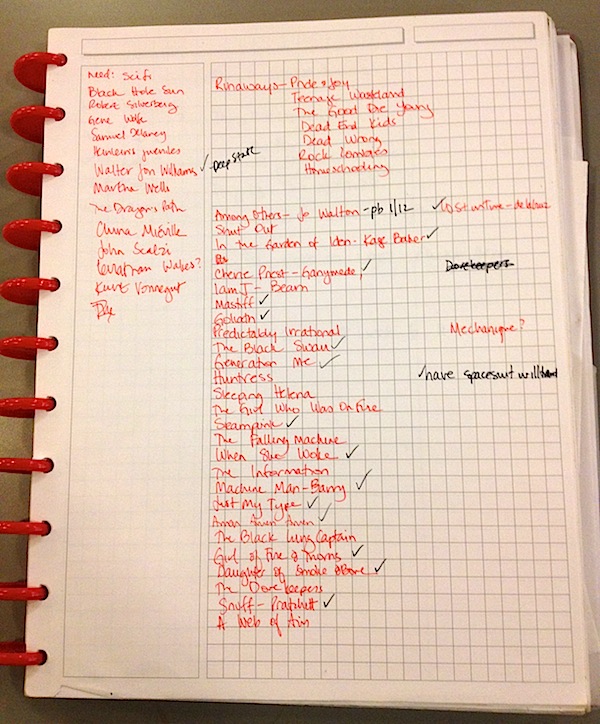
| Karyn's book list solution; all the information is there, but there is a lack of systems thinking. |
So we put our heads together, and considered the
problem. We browsed the Circa refill options (and also checked the fully compatible Arc options from Staples), but nothing was right, because
basically what we were looking for was an analog version of a digital tool – a
simple spreadsheet with specific columns. Finally, she said, “[Expletive
deleted], let’s just MAKE it!”
Following the age-old advice of Newsies, I said, “Okay, let’s do it.”
So we did!
Interested in making your own hack, combining the best virtues of analog and digital systems? Here’s how we did ours, laid out step-by-step with some annotations on our process.
A note to the less maker-minded out there: making your own templates doesn’t take an advanced degree in design or a lot of technical skill. All you need is a word processor (we like Microsoft Word), paper, a printer, and a willingness to experiment with formatting options.
(A sense of humor and a partner in crime help, too.)
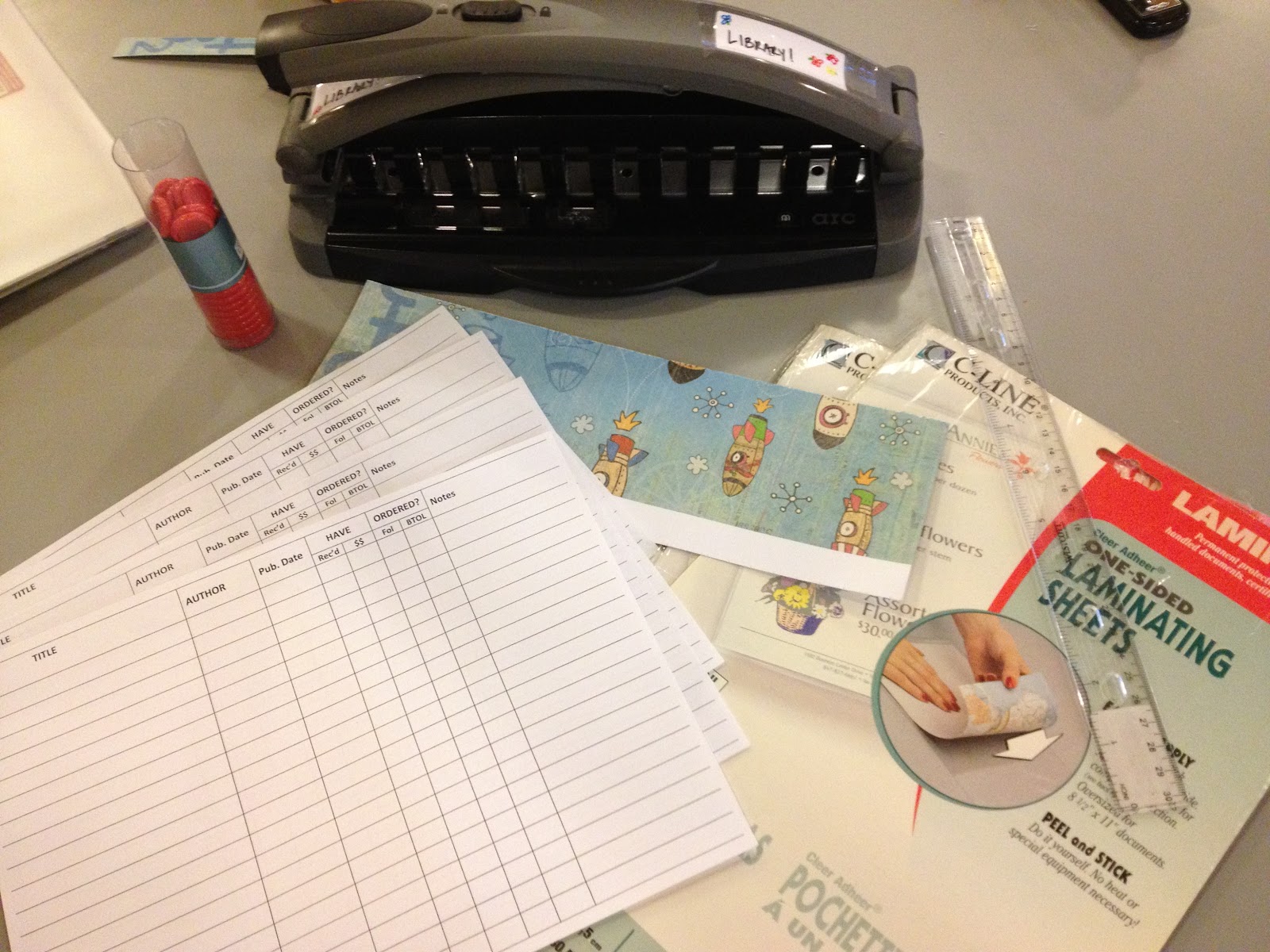
| Some of the supplies used for this project. |
- Computer with word processing (we used a Mac Air with Microsoft Word 2011)
- Binding system (we used Levenger's Circa Discs and a Staples ARC hole punch; you could also use: binder clips, brass fasteners, or loose-leaf rings.)
- Paper
- Printer
- Heavier stock craft paper and laminating machine or thin plastic suitable for a notebook cover
- Scissors & Ruler
(The remainder of our template instructions will include Word-specific commands; adapt as needed if you prefer Pages or another program; we don't recommend Google Docs for this level of design.)
2. Go to File > Page Setup and set up your page orientation. We used landscape, because that enabled us to create a spreadsheet layout.
3. In the menu, go to Format > Document to set your margins. Before changing any of the numbers, click on Mirror Margins. This sets inside margins (closest to the notebook spine) to be a bit larger than the outside margins (closest to the edge of the notebook). This is critical if you want to use every possible bit of the page and still have room for a binding.
(Karyn and I actually decided on margins last, but in hindsight, this is best done before inserting a table to the page.) You can see our margins in the screenshot below:
4. Click on Tables in the toolbar ribbon:
5. Click on New and use the cursor to choose your table size. We eventually ended up with 8 columns and 21 rows, but we started out with a 8 by 8 table, because you can always adjust columns and rows later.
We determined that we needed the following columns: Title, Author, Pub date, Have (with sub-categories for received and purchased; because of Karyn's blog, a lot of books come to us through channels other than traditional book ordering), Ordered (with sub-categories for our two primary vendors to enable easier tracking of ordered books), and Notes (with the idea that curricular connections, review sources, or specific student or faculty names might be part of the data we wanted to collect and remember).
You may decide that you need your template laid out entirely differently, and that’s the point: making your own template means
that you control how your information
is organized. It’s the maker mindset!
7. Adjust the column sizing by hovering your mouse over any column line until it becomes a line with two arrows, then click and drag the line to the desired width or height. In order to achieve sub-categories for the columns Have and Ordered, you can use the split and merge options in Table Layout. The functions work as advertised; split will split a single column or row, and merge will merge multiple columns or rows.

8. Add flair to your template by adjusting the palette. Add shading to your headers by clicking on Tables, and use the shading options under "Table Styles." Right click anywhere on your table, and choose "Table Properties" to change the style of the gridlines; we decided gray shading and the lightest possible gridlines was aesthetically pleasing and practical.
9. You can extend the left and right sides of the table off the page so that the lines extend as far as your printer will allow.
After A LOT of resizing, moving, font changes, and margin adjustment (and some wasted test pages), we ended up with this:
After a final test print of an inside and outside page, we printed the template double-sided onto higher quality paper and voilà. But wait! You’ll still want to bind it. And if
you also like a bit of zest in your office supplies, you’ll want to make a binding that
has a bit of style.
10. Cut beautiful paper slightly larger than 8 ½ x 11 paper. Laminate two pieces. These will be your front and back covers.
11. With the binding tool of your choice – ours was of course the specialty hole punch for Circa binding -- punch the appropriate edge of your covers and printed pages.
One of the initial challenges we faced was the desire for a notebook bound by the short edge. Short edge, top-bound notebooks exist (primarily legal pads), but we wanted a side-bound notebook laid out in landscape, something neither of us has ever seen commercially other than in photo albums.
Making our own binding allowed the notebook to be exactly what we wanted.
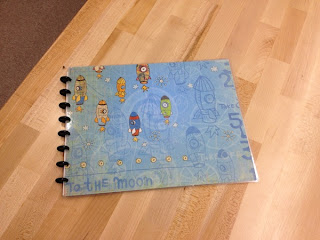
| The finished product. Isn't the cover paper adorable? |
13. Start using your new notebook!
This whole project took slightly over one hour (Karyn spent a large portion of that time carefully sifting through and then cutting cover paper; if you are less picky, the project time is dictated only by your table building skills, and those are pretty easy to acquire with a bit of trial and error).
During the creating process, a lot of our students came to investigate what we were doing, and were inspired to rethink their own organizational tools.
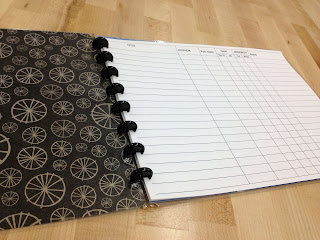
| Fresh pages, waiting to be filled in! |
So what are you hacking, modding, or otherwise recreating? How does the maker mindset inspire or help you on a day-to-day basis?
Subscribe to:
Posts (Atom)


